
Celia McCormick, Au.D
March 6, 2026
3 Min Read
You might find yourself at a favorite local restaurant or a busy family gathering, surrounded by the hum of laughter and clinking silverware. While you can hear that people are speaking, the actual words seem to dissolve into the ambient noise.
This experience is remarkably common for many patients we see at Family Audiology. You may feel that if the room were just a little quieter, you would follow the story perfectly. It is easy to assume these environments are simply too loud for anyone to navigate effectively.
However, struggling to distinguish speech in a crowded café or a social club is often the first sign that your auditory system is working overtime. You are likely noticing that while the volume of the world remains high, the clarity of individual voices has begun to slip away.
This phenomenon is one of the most frequent reasons individuals seek professional guidance. Recognizing this change early allows you to take proactive steps toward maintaining your social connections. You benefit from understanding that this is not a personal failing but a physiological shift in how your ears and brain process sound.
Why Background Noise Is So Challenging for the Brain
Your brain is a sophisticated processor designed to filter out irrelevant sounds while focusing on what matters. In a healthy auditory system, the brain effectively separates the frequency of a human voice from the low-frequency rumble of an air conditioner or the roar of a crowd.
You can rest assured that a healthy brain performs this "auditory scene analysis" almost instantly. When your hearing begins to change, often due to high-frequency hearing loss, this separation becomes blurred.
Speech sounds like "s," "f," and "th" provide the definition needed to tell words apart. When you lose access to these subtle cues, words start to blend into the background noise. It is not necessarily that the world has gone quiet; rather, the "signal" you want to hear is being smothered by the "noise" you want to ignore.
This creates a significant amount of listening effort. You may find that after an hour of intense concentration, you feel physically and mentally drained. This exhaustion stems from your brain working twice as hard to fill in the gaps of missing phonetic information.
Why This Often Becomes More Noticeable in Retirement
Retirement often brings a welcome shift in your daily routine, filled with more social outings and community events. You might spend more time traveling, attending group luncheons, or participating in local clubs.
These vibrant environments are exactly where hearing challenges tend to reveal themselves most clearly. In a quiet home setting, you may not notice any issues at all. It is the complexity of a multi-person conversation in a reverberant room that puts your hearing to the test.
These changes are frequently more about your lifestyle than your age. Because you are engaging more with the world in diverse settings, you are exposing your hearing to more demanding situations.
You might notice that you are asking others to repeat themselves more often during a busy Sunday brunch than you did in years past. Acknowledging these moments is a positive step toward ensuring you remain an active participant in your favorite activities. Understanding your specific needs starts with thorough diagnostic sessions that look at your hearing in various contexts.
The Hidden Impact of Constant Listening Effort
The strain of trying to hear in noise often leads to more than just a headache. You may find yourself withdrawing from conversations or choosing to stay home rather than face the frustration of a loud venue.
This gradual retreat can impact your confidence in social settings. When you have to guess at words or nod along without truly understanding, the joy of communication begins to fade. You are not alone if you feel a sense of irritation when a background television or a noisy fan makes it impossible to chat with a loved one.
Better hearing is not simply about making the world louder. In fact, increasing the volume of everything often makes the problem worse by amplifying the background noise along with the speech.
You benefit from solutions that prioritize clarity and speech preservation. By addressing these challenges early, you can reduce the mental fatigue that often follows a day spent in public. Choosing to partner with experts ensures that you receive a personalized strategy tailored to your specific social habits and communication goals.
How Family Audiology Approaches These Challenges
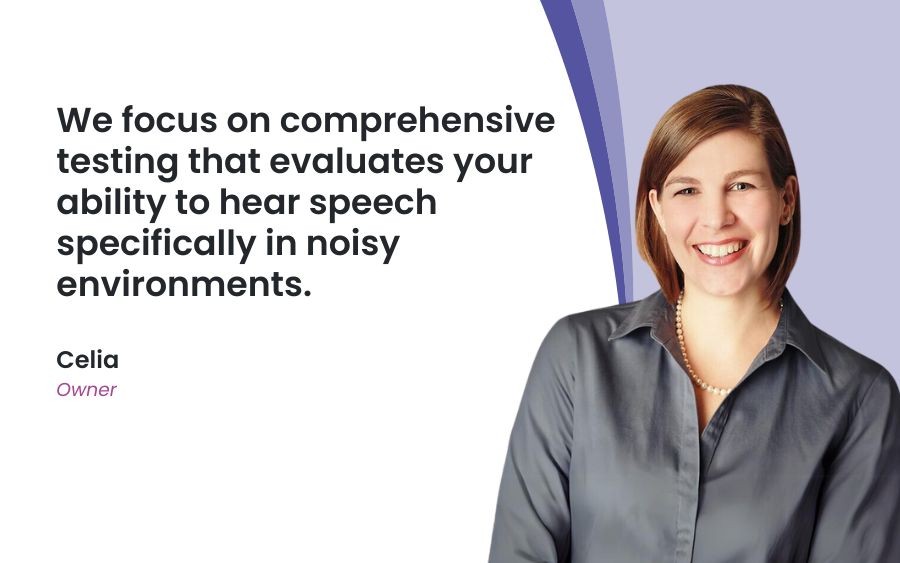
At Family Audiology, we believe that your hearing health requires a nuanced approach that goes beyond basic screenings. We focus on comprehensive testing that evaluates your ability to hear speech specifically in noisy environments.
This data is crucial because it mimics the real-world challenges you face every day. Our goal is to understand your unique listening landscape so we can provide recommendations that truly improve your quality of life.
You can rest assured that our process involves no shortcuts and no pressure. We prioritize education and long-term support over quick fixes.
Our philosophy is rooted in finding the right path for you, whether that involves lifestyle adjustments or innovative hearing solutions designed to filter out unwanted background clutter. We believe in building a lasting relationship with you, offering consistent follow-up care to ensure your technology is always performing at its peak.